<body><script type="text/javascript"> function setAttributeOnload(object, attribute, val) { if(window.addEventListener) { window.addEventListener('load', function(){ object[attribute] = val; }, false); } else { window.attachEvent('onload', function(){ object[attribute] = val; }); } } </script> <div id="navbar-iframe-container"></div> <script type="text/javascript" src="https://apis.google.com/js/platform.js"></script> <script type="text/javascript"> gapi.load("gapi.iframes:gapi.iframes.style.bubble", function() { if (gapi.iframes && gapi.iframes.getContext) { gapi.iframes.getContext().openChild({ url: 'https://www.blogger.com/navbar/36329712?origin\x3dhttp://writingaspirations.blogspot.com', where: document.getElementById("navbar-iframe-container"), id: "navbar-iframe" }); } }); </script>
Tuesday, May 08, 2007

Too Hero or Not Too Hero?

In December's Geekfest post from yesterday, she brings up a nice little discussion on the fallibility of heros and heroines. It's certainly not a new discussion, but it did get me thinking. Whether in a movie or in a book, a strong character can make or break the success. We've even heard it said that a story is only as good as your antagonist is bad.

Does that bad = to ultimate evil? In goodness or badness, characters must connect with the entertainee. I'm a fan of Heroes (the tv series). They've got an excellent villain in Sylar. A slightly twisted hero who believes other heros are broken and he is the only one who can fix them. Last night we got a glimmer of his humanity. He went to see his mom. He was questioning his future. The thought of just being "normal" was driving him. Did that weaken him as a character? No, it only made him more fascinating as a character to watch develop.

I have seen many first time writers (yes, even my own work *sigh*) write heroes that are too good and perfect and villains that are too evil and sadistic. Perfection is boring. I'm not perfect. My husband isn't perfect. He stinks from time-to-time and doesn't do the dishes nearly enough in my mind. My mother isn't perfect, though she is a perfectionist. My father isn't perfect. He definitely has anger management issues. My children certainly aren't - so if all the people I love the most aren't perfect, why would I be interested in a pretend character who is?

Some of my favorite books are my favorites because of the characters within those pages. Same thing with television and movies. I love Dr. House. His character is twisted and loveable at the same time. Pendergast from the Preston and Child books is one of my absolute favorite characters, though, for a while, he did ride a tad close to being too perfect. There is a Julie Garwood book that I love because her heroine is just so loveable, but she has a bad habit of forgetting anything she is holding and picking up items that don't belong to her.

When you are reading and you have finished - what remains with you? The characters or the plot? I'm sure we have ones that fall into either or, and many that fall into both. Writers who understand the fundamental basics of personality and have a grasp of psychology tend to develop stronger characters. What is motivating this person? This person hates split pea soup, why? How does that dislike shape future decisions?

I enjoy characters who are real. Characters who have beliefs that I disagree with or who make decisions out of reaction instead of careful plot manipulation. What is probably my biggest pet peeve in character development is when communication is tailored specifically to achieve a plot goal, instead of communicating in the way that real people do. I often see this in some of the weaker romance novels, where the writer doesn't have too much external conflict and it seems the only internal conflict she (or he) can really find is miscommunication or no communication at all... Yes, miscommunication happens, so does hiding from an emotion... but there is a fine line between "yeah, she's scared of rejection" and "Oh come on already, you are acting like a moron and I'm going to throw this against the wall."

One thing we writers should know, is how personalities work. I do believe that writers are as close to psychologists as someone can get, without actually being a psychologist. (at least the good ones anyway)

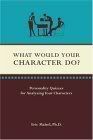
I have a book on characterization and I wanted to share an excerpt:

There is no one more expert about the psychology of personality than you. The ordinary clinician opens his bible, the Diagnostic and Statistical Manual of the American Psychiatric Association, and names your problem according to the symptoms you report. If you report that you've been feeling blue for a certain number of days, have had trouble sleeping, and experience little or no pleasure from life, a clinician runs his finger down the page, looks up, and says it's major depression. A writer does something very different.

A writer gets inside his sleepless, blue character and discovers that she is blue because she has contrived a loveless marriage that made sense from one point of view, the security angle, but was a horrible mistake from the purely human angle, since her husband is a cipher. A clinician says it's major depression. A writer says, "Hmm. Given the inner conflict, given that she really does love her walk-in closet but hates her husband, what is she going to do? What if I bring in, not a handsome stranger, but someone she'd never look at twice under ordinary circumstances but who, by virtue of the fact that she is so conflicted, begins to attract her in an obsessional way? Wouldn't that be interesting?"

- What would your character do? Eric Maisel & Ann Maisel

Labels: , ,

Monday, April 30, 2007

Death by Times New Roman


I once had a creative writing teacher tell me:
Kill a character your reader knows and it's a tragedy,
Kill a character your reader doesn't and it's a mystery.
For whatever reason, it's something that has stuck in my mind. I was thinking about writing my novel this weekend, and I say thinking because that's pretty much as far as I got with it. My novel is an action piece and as such, several stranger characters have already died. Really, they should have heeded the warning signs.
Anyway, I'm quickly coming to the point in my novel when one or two of the primary characters must bite the dust. They must be torn to pieces (yup, literally).
I find killing stranger characters easy and surprisingly satisfying. Nothing is quite so stress-relieving as writing someone's death by the teeth of a crazed jungle creature. And if the helpless victim resembles the jerk at work - all the better to make things more realistic, eh?
It's the build up to killing them off that's causing some obstacles for me. I don't want to suddenly pay too much attention to the character, but I also don't want the death to catch the reader completely by surprise. It's that balance...
So, how do you cope with the death of your characters? Do you go with a slow build or more of the direct approach with suspense? Do you treat death more as a tragedy or more as a mystery?

Labels: , , , ,

Thursday, January 11, 2007

Getting to know your character. #1 Results

Yesterday I made a post on a character prompt.

As promised, here are the thoughts on each character response:

Strengths:

Courage: Manifesting courage is consistent with a character who takes pride in standing up and in not failing himself or, alternatively, with a socialized character who falls into step with the norms of society, which includes acting a certain way in emergencies.

Presence of Mind: Manifesting presence of mind is consistent with a character who is a natural leader in emergencies, knows useful skills like first aid and CPR, and can be expected to think through - and then make - any hard choices that may confront her.

Resolve: Manifesting resolve is consistent with a character who has persevered through a lifetime of hard knocks and who has the self-awareness to recognize that in any situation, even the roughest, how she will react is in her control.

Calmness: Manifesting calmness is consistent with a phlegmatic character with a low heart rate, slow movements, and a calculating nature who likes to think before he acts and prefers quiet to bustle.

Self Control: Manifesting self-control is consistent with a character who has learned to manage anxiety through strictness and who knows how to ration scarce resources, denies herself treats, and is likely a fan of corporal punishment and of children being seen but not heard.

Weaknesses

Self-Pity: Manifesting self-pity is consistent with a self-indulgent, pampered character who is likely to whine, blame others, love material things, and lack empahy.

Cowardice: Manifesting cowardice is consistent with a secretive, grandiose character who feels both frightened and superior, and whose approach to danger is to hide and to let other inferior, disposable human beings do the dirty work and take the risks.

Lack of resolve: Manifesting lack of resolve is consistent with a blustery character who appears self-confident and can talk a good game but who is more anxious and frightened than she appears and who consequently falters in crunch time.

Mental confusion: Manifesting mental confusion is consistent with a character who lacks real autonomy and independence, who likely thinks of himself as dumb, silly or addled, and who leaves the decision-making process to others - like a mate or parents - while internally criticizing those decisions.

High anxiety: Manifesting high anxiety is consistent with a generally anxious character whose anxiety escalates in emergencies, reaching phobic proportions, and culminating in panic and hysteria.

Labels: , , ,

Wednesday, January 10, 2007

Getting to know your character. #1

While I'm reading the First Five Pages, I'm also flipping through another book I picked up recently: What would your character do? It's a neat little book that has some good advice on building a character and then it presents many scenarios and answers... little character prompts really. I thought I'd share a prompt with you and see how your character responds.


A MOMENT OF HIGH DRAMA

Out of the blue, your character is confronted by a moment of high drama. Depending on the nature of your character and your novel, choose one of the following dramatic moments: (1) caught in a major earthquake; (2) unjustly arrested for murder; (3) tailing the kidnapper of a child; or (4) watching a loved one die unexpectedly.

Get the incident clearly in mind. What was your character doing before the moment of high drama commenced? What was she feeling? Picture the drama unfolding: the building beginning to shake, your character feeling the handcuffs going on, your character noticing a man snatching a child, your character hearing the loved one's death rattle. Once you have the incident clearly in mind, proceed to the following questions.

***************

1. What strength of character does your character manifest in this moment?

A) Courage?
B) Presence of Mind?
C) Resolve?
D) Calmness?
E) Self-control?

2. What weakness of character does your character manifest in this moment?

A) Self-pity?
B) Cowardice
C) Lack of resolve?
D) Mental confusion?
E) High Anxiety?

Think about your character. Pick a characteristic for each question. Tune in tomorrow. I'll list the descriptions of the different traits as detailed in the book.

Labels: , , ,